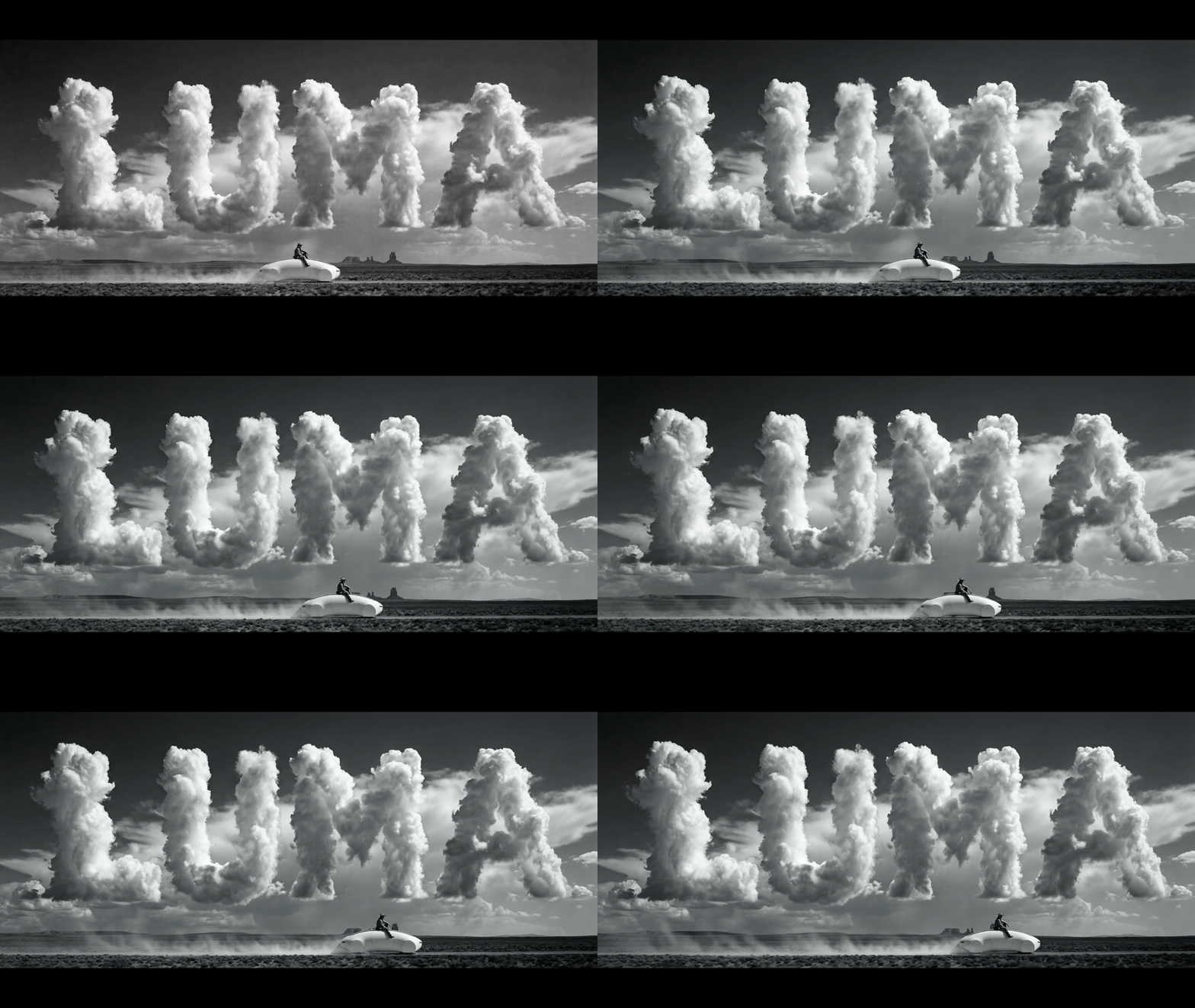
ai advertising

How I Became an AI Film Director After 20 Years in Advertising

From Nike campaigns to uncanny valley experiments to an AI commercial on ESPN—how Veo, Luma, and pure obsession unlocked a new way to make films without permission.

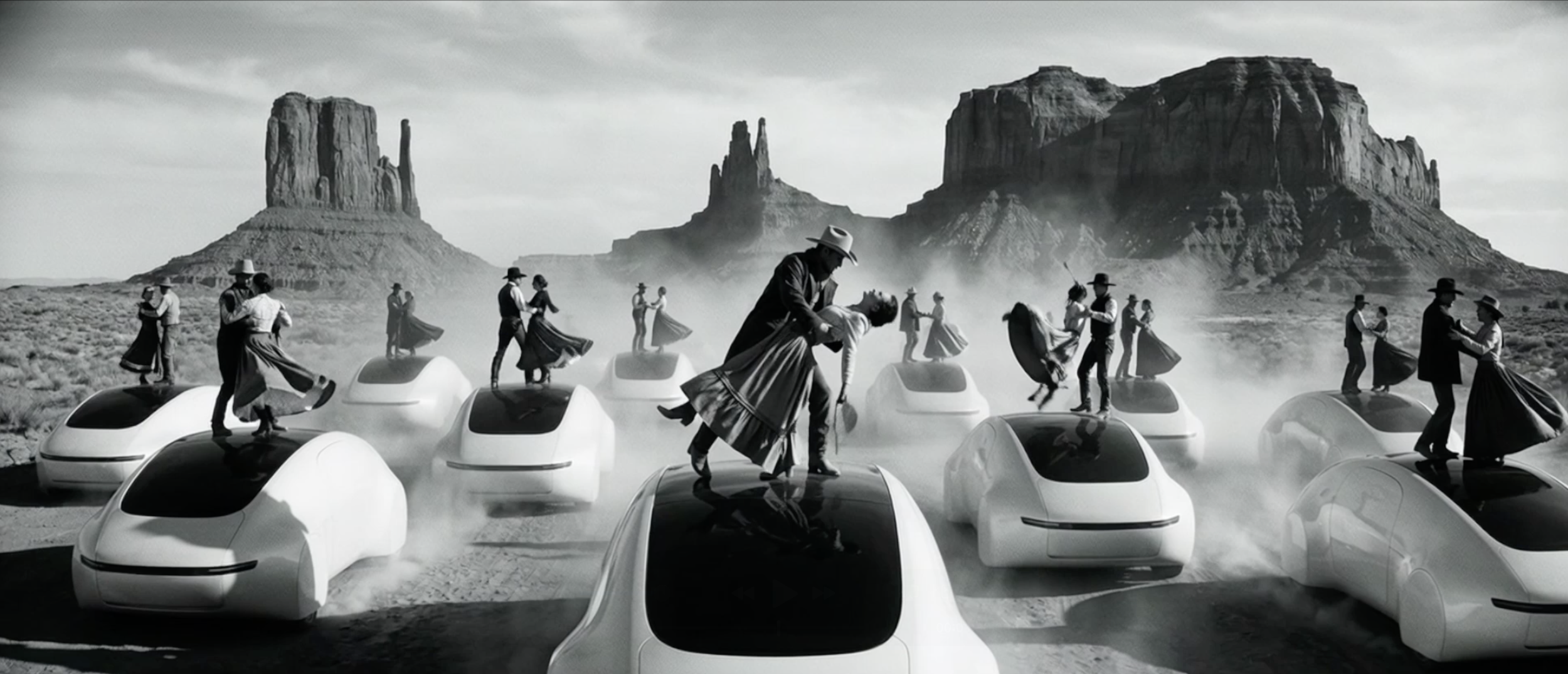
Still from Luma Taxi Dream Brief AI commercial. Written, directed, and produced by Andrew “Oyl” Miller. 2026.

For a long time, I stayed away from generative AI video tools.

What I saw in my feeds looked like memes and party tricks.

I’ve spent over two decades in advertising, writing and producing commercials and content for brands like Nike, PlayStation, IKEA, Amazon, and more. I had my routines, my established network, and my way of doing things. I’ve collaborated with and had deep creative discussions with legendary directors like Tony Kaye and Frank Budgen. I’ve been lucky enough to glimpse into a dream world of film, and I fell in love with the craft of it all. Yes, tools and taste are ever-evolving, but I deeply fell into a belief that traditional film techniques are the only way.

But then, last year, Google dropped a generative AI video model called Veo 3. I soon saw a random clip of an AI-generated character speaking, with near-perfect lip-sync.

That was the Big Bang of my rocketing journey through the AI film universe.

Suddenly, a lifetime of imaginary characters and dormant stories flashed through my head. Old directionless fragments and shards of ideas in dusty notebooks suddenly had new life. There was so much inside of me that had never found a proper outlet or received the official industry blessing. But when the sky cracked open, and I saw that a cluster of pixels could approximate life and human-ish performance, the writer in me started shaking. I didn’t know exactly where this was going, but I was suddenly, violently compelled to get these ideas out.

Welcome to the Infinite Sandbox in the Uncanny Valley

I started with the low-hanging fruit: Stormtroopers. As a lifelong Star Wars nerd, placing Stormtroopers into our everyday world was a cheap engine for endless gags. They went camping, they went to Cannes, they went to Burning Man. The possibilities were literally endless. It became a meme. Others jumped on.

But soon, I knew I needed to get my own voice out there. I saw AI not just as a way to create blockbuster spectacle, but as a potential platform for unique writing and voice. So naturally, I dipped into the 1980s.

I started thinking about archaic, crusty baseball coaches who hated the modern game. Men triggered by everything, armed with zero self-awareness and iron-clad beliefs from an ancient era. Being in advertising, I knew a funny character wasn’t enough. I needed a platform. I needed world-building.

That became Deadball Academy. Set in present-day Scottsdale, it’s a facility run by a group of coaches stuck in 1984 who bring in modern baseball prospects and corrupt them with deeply backward instruction. It’s a whole universe with lore and bizarre pockets of backstory. I quickly realized there was a LOT to mine here.

The episodes started writing themselves. Sometimes by hand, sometimes as fragmented dialogue and jokes in a notes app. When I strung together enough lines that made me laugh, I started building prompts. It became a new form of mini-screenwriting: establishing a setting, defining a character description, placing a line of dialogue, dictating the delivery, and always defining the cinematic camera look and movement.

Prompt. Prompt. Prompt.

Judge. Re-write. Edit. Curate.

The characters and voices came flooding back. Some were stuck in the uncanny valley; others looked insanely, undeniably good. Nothing was perfect, but it was allowing me to build a rip-o-matic for a cinematic universe that simply didn’t exist before.

Building in Public (and Becoming the Villain)

Whenever an idea outside of Deadball Academy popped into my head, I pursued it. I leaned into Midjourney to test visual styles. I used Suno to tap into my love of songwriting, generating rough, pounding tracks to score my films. Quickly, I was building up a workflow and stack of tools that let me operate a film studio right at my desk.

All the while, I was building in public.

And the internet reacted exactly how you’d expect. I started getting nasty DMs and anonymous trolls flooding my channels. I get it. AI is polarizing, and like it or not, I’ve become the bad guy to some people. But my curiosity, and the voices demanding to be let out of my head, wouldn’t let me stop. Sorry, not sorry. You don’t last in advertising without developing a bulletproof coping mechanism for intense criticism. I just kept pushing. I hear the voices, and the silent judgement, and I keep going.

I’m not looking for your approval. I’m looking for possibilities.

The Trojan Horse and the Million-Dollar Brief

Then, the inbound interest started.

One of those calls turned into writing and directing my first AI commercial, for cybersecurity start-up Proofpoint, which actually aired on ESPN. That is still an insane sentence to write, but it’s internet fact now. I’ve got the receipts. I partnered with the visionary team at ONLYCH1LD, and their openness to this new form was infectious. I even made a bonkers BTS gag reel using the “lead actor” from the Proofpoint spot, CLIFF DATAMAN. Yet another exercise in using the tools for world-building. I just keep leaning into the tangents I find most interesting.

Right around that time, an old Wieden+Kennedy colleague reached out about the Luma Dream Brief.

The AI film contest from Luma AI asked AI directors to use the Luma model to make an ad for a fictional Luma-branded product. Entries would go before a panel of advertising, film, and creative industry legends. Their picks would then be run as real ads for Luma, and officially submitted to Cannes Lions.

I’m not an awards hound, but I recognize how they contribute to career momentum. The thought of creating breakthrough work in an emerging film category was a strong motivation. On top of that, the contest also offered a one-million-dollar prize if the AI commercial ends up winning a Gold Lion.

As someone who has had some of my best work not given the blessing to submit to Cannes and other festivals, for weird, internal political reasons, the idea of no gatekeepers and a chance at entry appealed to me. Gatekeepers in advertising can be brutal. This contest arrived at the exact right time, offering a clean path to submit something with my uncompromised vision directly to Cannes, complete with a shot at a million dollars.

I dove into Luma’s tools and quickly built up a series of spots. What Luma did was validate my deepest belief: the best idea can come from anywhere. Committees, meetings, and endless feedback loops obfuscate that truth. Luma provided a cheat code to circumvent the murky layers of the industry. No feedback. No hidden agendas. No rubber stamps.

Just a clean shot.

If someone wanted to pair a multi-generational yakuza epic with a hard sell for laundry detergent, no one could stand in the way.

What’s Next?

This is where I stand in 2026. Turning a new page, letting my curiosity drive the way.

I will keep pushing, refining, and mastering these tools. But more importantly, I am looking to push beyond advertising. I’m looking to formalize series and put my voice out there in bigger, longer, more ambitious ways.

I have drafts of screenplays and novels waiting in the wings. I now see a world where AI filmmaking bridges the gap between a written page and a green light that I’ve been chasing for years at the end of a long and winding tunnel. Proof of concepts. Opening scenes. Theatrical trailers. That is the new brief.

My mission statement is this: I will keep making things that no one is asking for.

How can I use AI not just to increase my output or be more efficient, but to truly amplify my voice and get my stories made? It’s a crazy dream. It’s a lonely road. But the curiosity and possibilities keep me building. Studio Oyl.

What that means is I’m just a guy at a laptop, letting my fingers do the dreaming.

Andrew “Oyl” Miller is an advertising Creative Director, Copywriter, and AI Film Director. He spent 15 years working at Wieden+Kennedy on brands like Nike, PlayStation, MLB, Amazon, and IKEA—and is now one of the first people to direct a fully AI-generated commercial for broadcast television. You can check out his work on his website.